As organisations across the UK public sector actively transition into more digital, data-rich and AI-shaped operating environments, a basic question keeps surfacing for me.
Why are we still so often trying to stretch existing leadership structures over digital change, rather than building leadership models that are genuinely fit for a technical age?
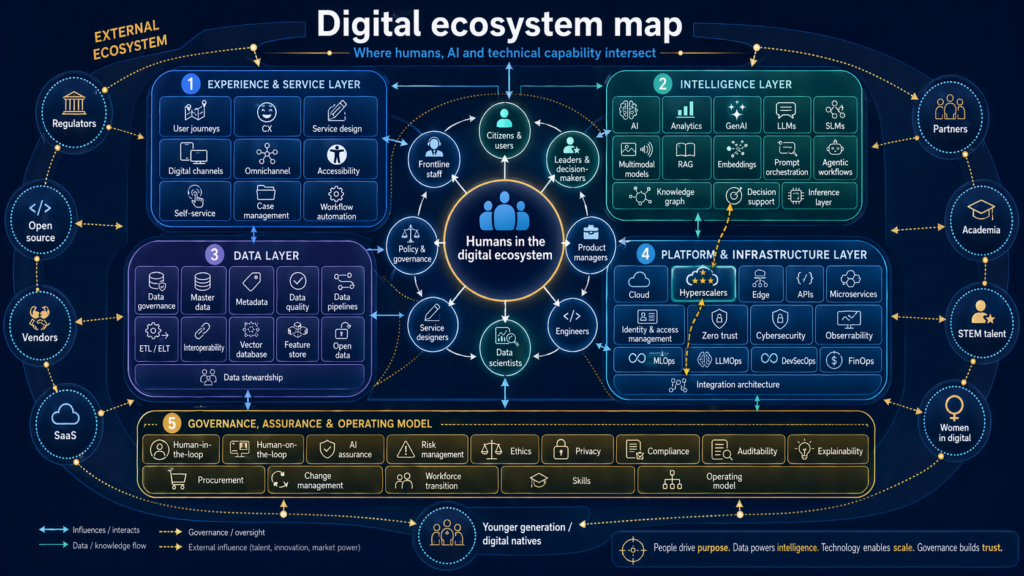
Across my work in the UK public sector, and through wider conversations connected to the EU Women in Digital programme, the pattern is strikingly consistent. The real issue is rarely the absence of technology. It is the gap between the language of transformation and the leadership capability needed to govern it well.
People are not asking for more jargon. They are asking for better judgement. They want to know how to ask better questions, make better decisions, challenge proposals more intelligently, work across silos, and connect digital choices to service outcomes, resilience and value.
That should force a reset in how we think about digital leadership.
Because too often, the response still seems to be: give existing leaders some best practice, a toolkit, a few prompts, enough vocabulary to sound current, and call that digital maturity.
I do not think that is enough.
In a world where hyperscalers are dominant, platform dependency is real, and AI capability is increasingly concentrated in powerful commercial actors, public institutions cannot afford to confuse familiarity with competence. These firms cannot be ignored. Nor should they be expected to close the capability gap for the public good. They are commercial entities. They will quite rationally make money from the very gaps institutions leave unaddressed.
That is why the answer cannot simply be to “scrape digital” across existing leadership structures and hope the market will do the rest.
The issue is not whether every leader needs to become an engineer. They do not. The issue is whether leadership is willing to carry the burden that comes with digital authority: judgement under uncertainty, engagement with risk, respect for technical expertise, and enough fluency to recognise when a proposal is weak, when a dependency is dangerous, or when a polished narrative is standing in for a viable operating model.
That is the difference between leadership and performance.
Culture is not peripheral
One of the most persistent mistakes in this space is to treat culture as the soft issue.
It is not soft. It is structural.
Many organisations still position digital development as an additional burden rather than a better way of working. Learning is too easily framed as exposure, assessment or compliance. Capability conversations can become performative. Staff resistance is then misread as a lack of enthusiasm for change, when in reality it is often a rational response to ambiguity, distrust or poorly explained intent.
This matters because culture is the operating environment in which digital judgement either develops or collapses.
If leaders do not create trust, clarity and legitimacy around technical learning, then frameworks become paper exercises, adoption becomes shallow, and transformation becomes a vocabulary layer placed over unchanged behaviours. Institutions then wonder why the tools are present but the change is not.
The real question is not whether people have been shown the technology. It is whether the organisation has created the conditions in which digital tools can be used well, challenged appropriately, and connected to genuine service improvement.
Technical credibility still matters — perhaps more than ever
There is a serious category error emerging in some leadership discussions.
It goes something like this: leaders do not need to be technical, therefore technical depth is secondary, therefore a light-touch toolkit plus some confidence-building is enough.
That logic does not hold.
Leaders may not need to build systems themselves, but they do need enough practical understanding to govern decisions shaped by architecture, data quality, cyber risk, delivery sequencing, procurement, vendor dependency and operational constraints. Without that, “digital leadership” becomes largely symbolic.
Toolkits can support judgement. They cannot replace it.
Frameworks can help leaders ask better questions. They cannot tell leaders whether the answers are evasive, incomplete, commercially loaded, or strategically dangerous.
This matters even more now that hyperscalers and major platforms are so deeply embedded in the digital landscape. Public institutions need to engage these players intelligently, not from a position of dependency disguised as strategy. If organisations hollow out internal technical credibility while inflating the language of leadership, they do not become more mature. They become easier to sell to.
That is why technical expertise cannot be treated as something peripheral or inconvenient to leadership. It is one of the things leadership must know how to work with, protect and elevate.
Stop alienating the people the future depends on
This may be the deepest failure of all.
Technical people exist. Hybrid leaders exist. Women in digital exist. Younger professionals coming through STEM, data, cyber, service design and engineering routes exist. They are not waiting to be introduced to technology by legacy systems. They are already living in it, working in it, and understanding it as part of how society, work and identity now operate.
Yet too many organisations still appear more comfortable rewarding familiar authority than recognising modern capability.
If progression remains tied to narrow hierarchies, static role patterns and conventional notions of leadership, then institutions will continue to overlook the very people they most need: those who can translate across boundaries, combine delivery credibility with strategic judgement, and operate comfortably in complexity without turning it into theatre.
This is not only about fairness. It is about future-readiness.
If institutions keep sidelining technical expertise, under-recognising hybrid leadership, and treating younger generations as consumers of technology rather than shapers of it, they will keep weakening their own leadership pipeline. They will also reinforce a damaging message: that real expertise is welcome only once it has been stripped of friction and made safe for legacy power.
That is not a digital leadership model. It is a defensive adaptation by an older one.
There is also something wider going on here: a pathology of the current transition. Technology is no longer external to life. For younger generations especially, it is embedded in communication, identity, learning, work, culture and expectation. That does not make every young person automatically expert, but it does mean institutions are increasingly out of step if they continue to imagine digital capability as an optional add-on to traditional leadership rather than part of the basic fabric of modern organisational life.
The choice now
The choice is not between old leaders and new technology.
The choice is between two models of leadership.
One model treats digital as an adjunct to existing authority. It assumes leaders can be lightly equipped with best practice, some governance language and a few tools, while technical depth remains something to borrow, outsource or hold at arm’s length.
The other recognises that digital leadership is now a substantive capability. It values translation, delivery credibility, technical respect, practical judgement, and leadership pathways that do not force every capable person into an outdated managerial mould.
Only the second model is equal to the world now taking shape.
So no, hyperscalers cannot be ignored. But neither should they be allowed to define the limits of public capability. No, every leader does not need to become a specialist. But neither can leadership continue to claim digital authority while remaining insulated from technical substance.
Most of all, institutions need to stop alienating the technical and hybrid talent already in the system, and stop designing leadership pathways as though the future will patiently wait for legacy structures to catch up.
It will not